What Is Decentralized Finance (DeFi)?
Last Updated: Jun 30

DeFi
Key Takeaways
- Decentralized finance (DeFi) refers to financial products and services built on blockchain infrastructure that operate without traditional intermediaries like banks, brokerages, or clearinghouses. DeFi applications use smart contracts to automate financial transactions, enabling peer-to-peer lending, trading, and more.
- DeFi automates core financial functions with smart contracts enabling lending, trading, settlement, and other activities, all without traditional intermediaries.
- Anyone with internet access can participate, with all transactions publicly auditable.
- DeFi protocols can interact seamlessly, building upon each other like “Lego blocks", enabling complex financial products.
- Tokenized Treasuries, stocks, and stablecoins bring institutional-grade assets into DeFi protocols.
Traditional finance operates through intermediaries; banks facilitate deposits and loans, brokers execute trades, and clearinghouses settle transactions. Each intermediary adds costs, delays, and limitations.
Decentralized finance (DeFi) reimagines the traditional financial system by using blockchain technology and smart contracts to enable direct peer-to-peer financial services, operating 24/7 with global accessibility.
"Decentralized finance and blockchain are real, new technologies that can be deployed in both public and private fashion, permissioned or not." — Jamie Dimon, CEO of J.P. Morgan
How DeFi Works
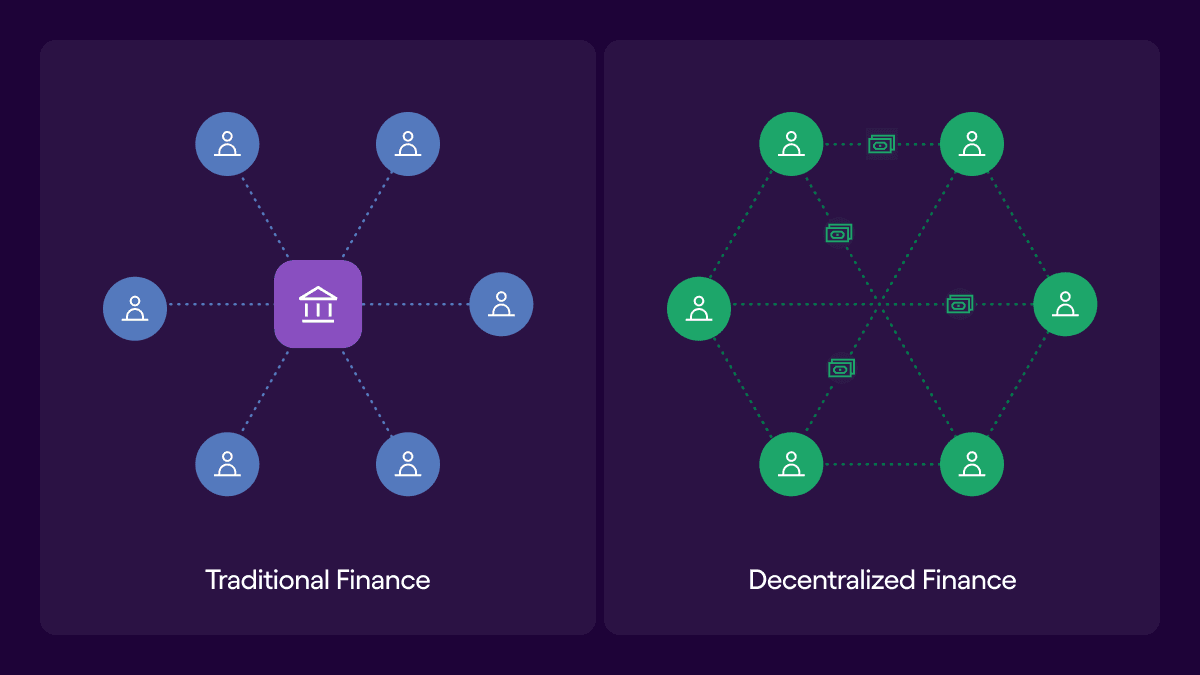
Traditional finance relies on financial institutions as intermediaries, while decentralized finance enables peer-to-peer transactions.
Think of DeFi as financial services that run automatically with code rather than through banks and other financial institutions:
- Smart contracts replace middlemen: They automate the operations of traditional financial intermediaries.
- Anything can be tokenized: Treasuries, stocks, ETFs, and other real-world assets have all been tokenized and can be deployed across the DeFi ecosystem along with crypto-native tokens like ETH and BTC.
- Wallets are the account: A wallet address is the DeFi account. No usernames or logins required, users simply connect a wallet to a decentralized application (dApp), take an action, and approve the transaction.
- Gas fees are transaction costs: Gas fees compensate validators for processing transactions. Fees vary by network congestion and transaction complexity; simple swaps cost less than multi-step strategies.
- Everything happens onchain: Every DeFi action is recorded as a blockchain transaction, creating an auditable history that anyone can verify in real-time.
- Liquidity pools power trading: Instead of matching buyers and sellers through centralized orderbooks, automated market makers (AMMs) source liquidity from token reserves with prices determined algorithmically.
- Full collateralization or overcollateralization instead of fractional reserves: To borrow $10,000 in stablecoins from a lending protocol, a user might lock $15,000 worth of ETH, which is automatically liquidated if its value falls too low to ensure protocol solvency.
- Deposits become tradable tokens: When a user deposits assets into protocols, they receive tokens representing the position, which can accrue value and be redeployed elsewhere.
- The risk-reward reality: Smart contract exploits, lost keys, and volatile markets pose irreversible risks. Users gain full control but accept full responsibility.
Key DeFi Benefits
1. Permissionless Access
Anyone with a blockchain wallet can interact with DeFi smart contracts, regardless of credit history or net worth. However, some applications implement geo-blocking, allowlists, and blocklists.
2. Transparency
Every transaction is publicly visible and cryptographically verifiable. Protocol code is typically open source. Users can verify things like how much capital is deployed, current rates, and outstanding loans, unlike traditional finance's quarterly disclosures.
3. Composability
DeFi protocols function as programmable building blocks. Smart contracts can automate strategies spanning lending, trading, and rebalancing without requiring formal partnerships.
4. Non-Custodial Control
Users maintain direct ownership of assets through self-custody wallets, reducing counterparty risk from institutional failures. However, this introduces responsibility for securing private keys.
DeFi Use Cases
1. Decentralized Lending and Borrowing
How it works: Lenders deposit assets into smart contract liquidity pools. Borrowers provide collateral and receive loans algorithmically, with interest rates adjusting based on supply and demand. Smart contracts monitor collateral ratios and trigger automatic liquidations if needed.
Leading protocols: Compound introduced algorithmic interest rate models, Aave became the largest lending and borrowing protocol by total value locked, and Flux Finance became the first lending protocol to accept tokenized Treasuries as collateral, bridging traditional and decentralized finance.
Key benefits: 24/7 operation with global accessibility. Users can borrow stablecoins using crypto or tokenized assets as collateral, accessing USD liquidity without traditional banking relationships. No credit checks are required for crypto-collateralized loans, settlement is instant, and utilization rates are transparent.
2. Decentralized Exchanges (DEXs)
How it works: Liquidity providers deposit token pairs into smart contract pools. Algorithmic formulas determine token prices based on pool ratios. Traders swap directly against pools, with fees distributed to liquidity providers.
Leading protocols: Uniswap popularized the constant product formula (x*y=k) that became the foundation for automated market making (AMM), while Curve optimized for stablecoin and stable asset trading with minimal slippage. Today, DEXs facilitate trillions in annual volume.
Key benefits: Permissionless trading, transparent pricing, and global access. Trade crypto and tokenized assets 24/7 without relying on traditional intermediaries.
3. Yield Optimization
How it works: Yield aggregators automatically deploy user deposits across a number of DeFi opportunities to generate yield. Smart contracts handle harvesting, compounding, and rebalancing without manual intervention, continuously optimizing returns.
Leading protocols: Yearn Finance pioneered automated yield optimization strategies, while Beefy Finance expanded multi-chain yield farming.
Key benefits: Investors earn optimized returns without constantly monitoring rates across protocols or paying high gas fees for frequent rebalancing. Small holders access sophisticated strategies previously available only to large capital pools. Automated rebalancing and gas-efficient harvesting benefit all depositors.
4. Prediction Markets
How it works: Users buy and sell shares representing potential outcomes of future events, with prices reflecting collective probability estimates. When events resolve, shares for correct outcomes pay out while others become worthless. Smart contracts automate settlement based on oracle data or decentralized resolution mechanisms.
Leading protocols: Augur pioneered blockchain-based prediction markets. Polymarket later became the largest prediction market platform, processing billions in volume during major elections and events.
Key benefits: Market-driven forecasting with 24/7 global access, transparent odds, and permissionless participation. Traders speculate on election outcomes, economic indicators, or sports results while gaining market-aggregated probability estimates. Businesses and researchers use prediction markets for forecasting and risk assessment.
5. Derivatives and Options
How it works: Protocols offer perpetual futures and options trading through smart contracts, enabling leveraged positions and hedging strategies without traditional intermediaries. Smart contracts automatically manage margin requirements, funding rates, and liquidations.
Leading protocols: dYdX pioneered decentralized perpetual futures with an order book model and Hyperliquid built a fully onchain order book with no oracle dependencies for perpetuals trading. Ondo Perps optimized for equity perpetuals, becoming the first platform to accept tokenized stocks as collateral alongside stablecoins, enabling seamless hedging and superior capital efficiency.
Key benefits: 24/7 trading and transparent onchain settlement, where traders can access derivatives markets without traditional exchange accounts or KYC requirements. Positions can be managed programmatically and integrated with other DeFi strategies.
6. Decentralized Insurance
How it works: Users purchase coverage for smart contract exploits, protocol failures, or other onchain risks. Capital providers stake funds as underwriting capacity and earn premiums.
Leading protocols: Nexus Mutual pioneered decentralized coverage for smart contract risks with member-governed claims assessment.
Key benefits: Users protect against smart contract risks that traditional insurance doesn't cover, while capital providers earn yield by underwriting risk.
7. Stablecoins and Cross-Border Payments
How it works: Stablecoins maintain stable value referencing fiat currencies (typically USD).
Leading protocols: Circle's USDC and Tether's USDT dominate the market.
Key benefits: Instant settlement at low cost, 24/7 availability, global accessibility without bank accounts. Settling trillions annually, stablecoins are DeFi's most successful application to date.
8. Tokenized Real-World Assets in DeFi
The integration of tokenized Treasuries, stocks, and other real-world assets represents the convergence of traditional and decentralized finance.
How it works: Tokenized assets function as composable DeFi primitives. They can serve as collateral in lending and perps protocols, provide liquidity in trading pools, or participate in yield strategies.
Real-world examples: Flux Finance accepts tokenized Treasuries as collateral for borrowing stablecoins, enabling users to maintain Treasury exposure while accessing liquidity. Similarly, liquidity pools pairing tokenized stocks with stablecoins enable 24/7 equity trading. Ondo Perps takes this further, allowing traders to post tokenized stocks directly as collateral for perpetual futures positions, enabling seamless hedging of spot and derivatives exposure on a single platform.
Why this matters: This integration brings billions in traditional assets into DeFi's composable ecosystem, extending accessibility, transparency, and programmability to institutional-grade assets. The same composability that made DeFi powerful for crypto-native assets now applies to mainstream financial instruments.
Key DeFi Infrastructure
Wallets
Non-custodial wallets like MetaMask and Rabby, and hardware wallets like Ledger and Trezor enable users to interact with protocols while controlling private keys.
Oracles
Many DeFi protocols require reliable external data, particularly asset prices. Oracle networks like Chainlink aggregate data from multiple sources and deliver it onchain, providing the price feeds that lending protocols, derivatives platforms, and other applications depend on.
Cross-Chain Bridges
Bridges enable asset transfers across different blockchains, expanding accessibility and reducing liquidity fragmentation across ecosystems.
Institutional Infrastructure
Qualified custodians provide institutional-grade custody and security while enabling DeFi interactions.
Risks and Limitations
While DeFi offers significant opportunities, users should understand the risks inherent to decentralized systems. These risks differ from traditional finance and include:
1. Smart Contract Risk
Code vulnerabilities can lead to catastrophic losses as there are no in-built mechanisms to reverse fraudulent transactions or recover stolen funds. Historic exploits have drained billions from protocols.
2. Oracle Manipulation
Price oracles deliver external market data to DeFi protocols, creating a point of vulnerability. Flash loan attacks have exploited vulnerable price feeds to artificially inflate asset values, allowing attackers to manipulate collateral ratios and drain funds from a protocol.
3. User Experience Complexity
Users must understand how to use a Web3 wallet, pay for gas fees, and execute transactions. Mistakes can be costly and irreversible.
The Future of DeFi
DeFi has evolved from experimental protocols into mature infrastructure processing trillions in annual transactions. Tokenized Treasuries, stocks, and other traditional assets are expanding DeFi beyond crypto-native instruments, while major financial institutions are deploying capital into DeFi protocols, validating the technology at scale.

Further Reading

What Is a Decentralized Exchange (DEX)?
Decentralized exchanges (DEXs) are blockchain-based trading platforms that enable peer-to-peer cryptocurrency and tokenized asset trading, using smart contracts instead of centralized order books.

What Is Decentralized Lending and Borrowing?
Explore decentralized lending and borrowing protocols, how they work, key benefits like permissionless access, and how tokenized assets serve as collateral.

What Are Stablecoins?
Stablecoins are digital tokens designed to maintain a stable value, most commonly pegged to the U.S. dollar.
